The Kettle Isn’t Dead Yet: Maintenance Lessons from a Repair Café Table
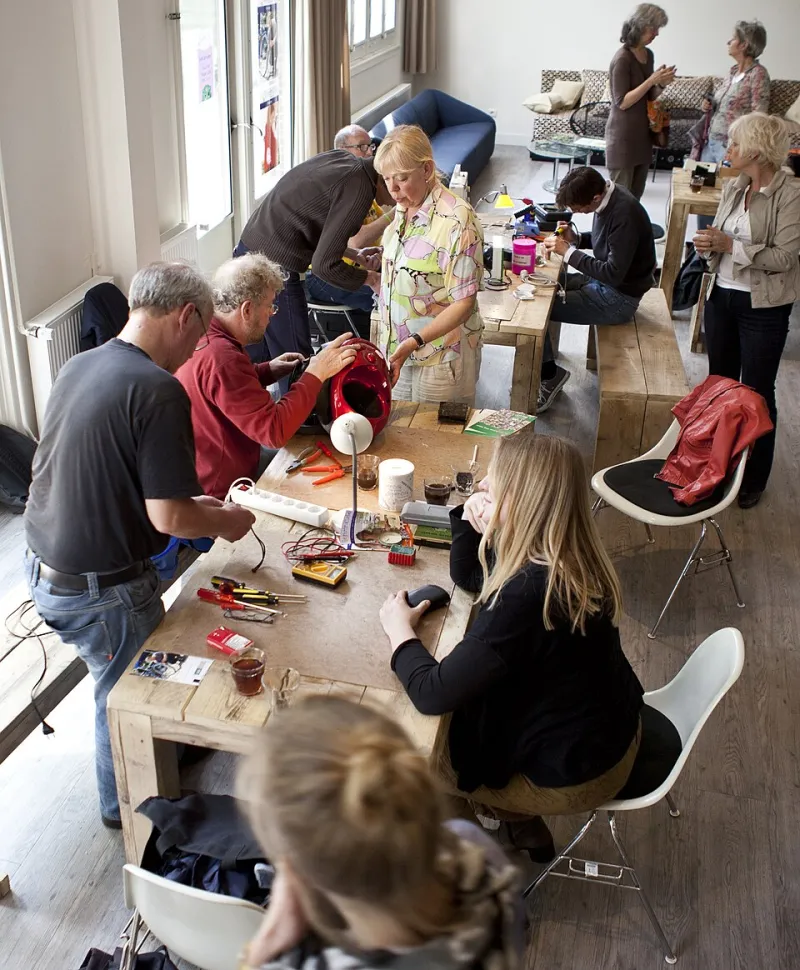
Photo: Ilvy Njiokiktjien, CC BY-SA 3.0, via Wikimedia Commons
The kettle had been dying for months. Not dramatically — no sparks, no smoke, no farewell speech. It just took longer to boil, clicked off early, and left a faint smell of hot plastic in the kitchen. My first instinct was to replace it. Argos had a deal on. Currys had a slightly better one. I had a tab open before I’d even unplugged the old thing.
Then I remembered the repair café at the church hall down the road. Once a month, a few volunteers set out tables, plug in soldering irons, and see what can be saved. You bring a broken thing, you sit with someone who knows more than you do, and you learn a bit about how it works. Tea is available. Biscuits are not optional.
The kettle that wasn’t dead
I turned up with the kettle and a vague sense of embarrassment. It felt like bringing a papercut to A&E. But the volunteer — a retired electrician called Martin — took it apart on a tea towel, tested the fuse, cleaned the contacts, and showed me the limescale built up around the element. Twenty minutes later it was boiling again. The part cost £4. The donation tin got a tenner. I went home with a working kettle and a slightly bruised sense of my own throwaway instinct.
What stayed with me wasn’t the kettle. It was the table. Around me, someone was fixing a lamp, someone else was coaxing a sewing machine back to life, and a teenager was learning how to replace a plug fuse. Nobody was doing anything heroic. They were just refusing to bin things that still had a bit of life in them.
The throwaway instinct
I’m as guilty as anyone. A thing gets slow, scruffy, or slightly annoying, and I start browsing replacements. It happens with kettles, phones, and — more often than I’d like to admit — websites.
I have side projects that are still online because I haven’t got round to switching them off. One is a small directory I built around 2019. Another is a newsletter archive I keep telling myself I’ll redesign. A third is a half-finished tool that does one useful thing badly. They aren’t broken, exactly. They’re just tired. And tired is the exact state in which I tend to abandon things rather than mend them.
A website doesn’t smell of burning plastic. It doesn’t trip the kitchen fuse. It just quietly gets slower, older, and less secure. Broken links pile up. The contact form stops sending. The SSL certificate lapses. The hosting renewal lands and I think, right, maybe I should just start again.
Starting again is the digital equivalent of buying a new kettle. It feels decisive. It feels clean. It is also much more work than changing the fuse.
Websites don’t have a repair café — yet
There’s no church hall where you can turn up with a broken WordPress site and a volunteer called Martin will take a look while you eat a digestive. That’s a shame, because most of what needs fixing is unglamorous: updates, backups, a form that needs testing, a redirect that needs adding, a plugin that needs removing.
The repair café model works because it separates the problem from the panic. You don’t have to know everything. You just have to be willing to sit with someone and go through it step by step. The same is true of maintaining a side project. You don’t need a full rebuild. You need a list and a timebox.
A three-bucket audit
When I got home from the repair café, I opened a notes file and wrote down every side project I still pay for or feel vaguely guilty about. Then I put each one into one of three buckets: mend, retire, or ask for help.
Mend
These are the projects that still do one useful thing. They might look dated, but someone — often me — still uses them. The test isn’t whether I’m proud of them. It’s whether they earn their keep. A working contact form, a page that answers a question, a tool that saves me ten minutes a month: that’s enough. Mend means fixing the actual problem, not redesigning the logo.
Retire
These are the projects that no longer have a job. The domain renews out of habit. The content is stale. The tool broke two years ago and nobody noticed. Retiring isn’t failure. It’s maintenance of a different kind. Archive what matters, redirect what you can, and let the rest go. A retired project takes up less space in your head than a half-alive one.
Ask for help
These are the projects that are worth saving but beyond my current patience or skill. A security warning I don’t understand. A migration I keep postponing. A design problem I can’t see my way out of. The repair café lesson here is simple: ask earlier. A friend, a local meetup, a freelance developer, a forum, a paid hour of someone else’s expertise — all of it is cheaper than another year of avoidance.
The checklist I actually use
Before I decide whether to mend or bin a side project, I run through the same short list. It takes about fifteen minutes and saves me from making decisions based on vibes.
- Does it still do one useful thing for one real person?
- When did I last back it up, and do I know how to restore it?
- Are the core software, plugins, and hosting still supported?
- Is the domain name and email worth another year of renewal?
- What would I pay to replace it? What would I pay to mend it?
- Who could I ask for help, and what would I ask them to look at first?
- Can I timebox the repair to ninety minutes and one problem?
If the answers are mostly no, or mostly vague, it’s usually a retire. If there’s one clear problem and a reasonable way to fix it, it’s a mend. If I feel a small knot of dread, it’s probably an ask-for-help.
The biscuit economy of maintenance
The repair café runs on donations, tea, and the willingness of people who know how to do one thing well. It isn’t efficient. It isn’t scalable. It is, however, the most sensible approach to maintenance I’ve seen in a while.
My websites don’t need a growth strategy. They need a monthly half-hour where I check the backups, update the plugins, test the contact form, and look at the error log. They need a quarterly review where I ask whether each one still earns its renewal fee. They need me to stop treating replacement as the only grown-up option.
The kettle is still on the hob. It boils a bit slower than a new one, and the handle has a faint wobble. But it works, it was mended by a stranger in a church hall, and it has saved me from buying something I didn’t need. That feels like a decent standard for a side project too: not perfect, not new, but still doing a job — and still worth a bit of care.